How to Install an Aquarium Heater (Guide)
Most aquarium fishes need warm and stable water between 24 to 28 °C to stay healthy and grow. Without a heater, room temperature changes between day and night, and that can lead to stress for fishes, weaken their immune system, and cold water can trigger diseases like Ich. In this guide, we will show you the correct and simplest ways to protect your fish and aquarium.
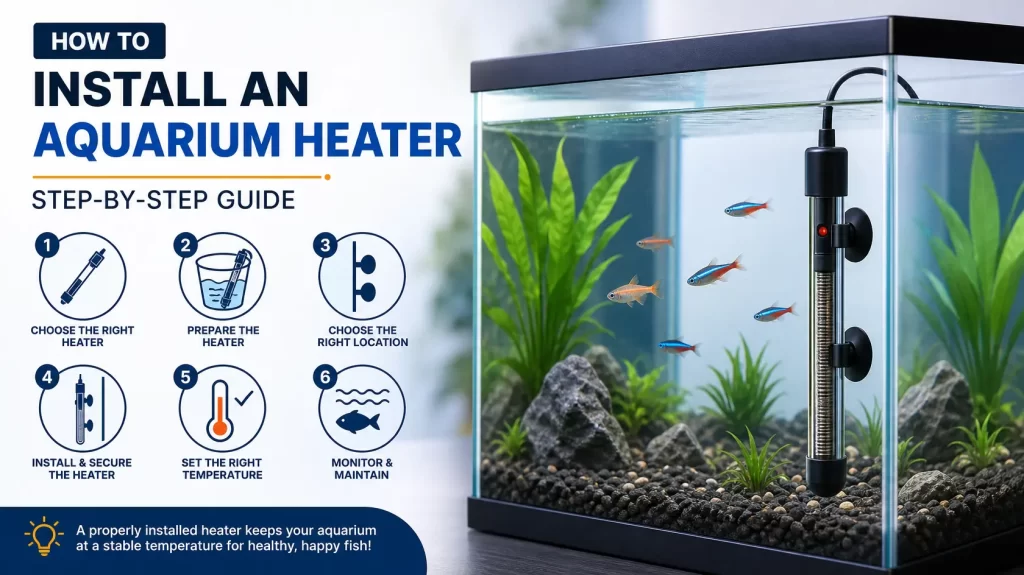
Install an Aquarium Heater
- Select a heater with about 1 watt per litre of water.
- First, unplug all accessories and equipment in the aquarium.
- Set the heater with suction cups near the water or filter inlet or outlet at an angle, so it maintains the temperature throughout the entire tank.
- Wait for at least 10 minutes, so the heater can adjust to the aquarium water temperature.
- Set the heater at 28 °C, the ideal temperature for all tropical fishes.
- You can use a separate thermometer to measure the temperature, or the heater will work on its own to maintain the temperature.
Types of Aquarium Heaters
| Heater type | How it works | Pros | Cons | Best for |
|---|---|---|---|---|
| Submersible | Underwater mounted with suction cups | Even heating, adjustable | Visible | Home aquariums |
| Hang-on | Hangs on the glass rim | Cheap, easy to setup | Not fully submerged | Small tanks |
| In-line | Canister filter tubing | Hidden, even heat | Costly | Large tanks |
| Substrate | Heating cable | Plant growth | Hard to setup | Planted tanks |
| Default | Temperature 26 °C | Simple | No change in temperature | Betta tanks |
Most hobbyists choose a submersible heater, and it’s the best choice. Look for good-quality glass and automatic shut-off when the temperature hits the set levels.
Aquarium Size and Heater Wattage Guide
A good rule is 1 watt per litre of water. Use a higher-wattage heater only if your room or house is cold or during the winter season, depending on the overall weather temperature.
| Tank size | Heater wattage |
|---|---|
| 20 L | 20-25 W |
| 40 L | 40-50 W |
| 70 L | 75–100 W |
| 100 L | 100–150 W |
| 150 L | 150–200 W |
| 200 L | 200–250 W |
| 250 L | 250–300 W |
| 300 L | 250 W * 2 |
PRO TIP: For aquarium tanks of more than 200+ litres, use smaller or multiple heaters instead of a single large heater. Multiple heaters spread heat more evenly, and if any one fails to do the job, the other heater will help to reduce the sudden water temperature drop or overheating of the water levels.
Aquarium Heater Placement in Fish Tank
The good spot for a heater is near the filter intake or outflow, where the water movement is more frequent, and it disperses heat throughout the whole tank and keeps the same temperature in the entire tank.
- Water flow: Beside the filter to spread heat evenly in the aquarium.
- Angle: Vertical or horizontal, diagonal position heats water more compared to the other positions.
- Keep away from substrate, gravel and decor: Touching the heater at the base or glass will create hot spots and crack the glass.
- Easy to set up and maintain: Check and adjust the temperature as needed.
Safety Tips for Aquarium Heater
- Unplug: Unplug the heater before water changes or maintenance or changing decor inside.
- Cool: Wait 10 minutes after the heater off, before taking it out of the water. Making changes or removing immediately will break the heater glass.
- Heater guard: Use heater guard, large fish species will break the glass or burn themselves.
- Change heaters every 6 months: Change even it’s working fine. Since thermostats start working abnormally.
Signs Your Aquarium Heater Is Failing
- Water temperature is hot or cold than the setting by more than 2 °C.
- Heater light stays on all the time or never starts to maintain the temperature.
- Cracks on the glass or water inside the heater glass tube.
- Fish gulping on surface or hiding in the aquarium tank.
Conclusion: Stable and Maintain Water Temperature
Setting up the heater in the aquarium tank is the very first step. Choose the right wattage, mount it near the filter intake, and angle it. To prevent water fluctuations, keep the tank away from direct sunlight, windows, and walkways.